


Explore all Mykonos Sights
Mykonos has many remarkable attractions that combine history, tradition and unique aesthetics. The picturesque windmills, the charming area of Little Venice with its colorful houses by the sea, as well as the church of Panagia Paraportiani, one of the most characteristic monuments of the island, stand out. In addition, a short distance away is the sacred island of Delos, an important archaeological site with great historical value.
Delos
The sacred island of the Ancient Greeks which, according to mythology, was revealed through the waves of the Aegean Sea by Poseidon to Leto, pursued by Hera, who there gave birth to Apollo and Artemis.
On Delos, the ruins of one of the largest and most impressively organized settlements of Greco-Roman antiquity are preserved in fairly good condition.
The archaeological Museum of Delos is today one of the most important in Greece. Delos and Rheneia are under the protection of the Ministry of Culture and the docking of boats and overnight stays of people without special permission are prohibited.
Drafaki, Vrysi, Glastros, Platy – Gialos
Interesting small monuments are scattered in rural – until recently – areas and in the South of Chora: in Drafaki (Paspari), one can see some very old but well-preserved chapels. In Vrysi, a Mycenaean period vaulted tomb, unusual for the Cyclades, was discovered a few years ago, with a rich and interesting content that testifies to the special relations of the island with the Greek Mycenaean centers.
In the Mykonian countryside, the ruins of some ancient square or round towers are still preserved, which must have belonged to some defensive system of the island: The tower at Lino, 10m in diameter. The tower at Portes, which dominates Platy – Gialos.
There are also ancient wells that are still in use, such as the “Yiannaros” well, an underground cistern built with granite stones and a staircase for descending into the water.
Another well, “Pouados”, with steps on the side to ensure easy access, is preserved under the Tourlos – Korfou ring road, at the height of Tangou.
Little Venice
Between Kastro and Skarpa is the picturesque neighborhood that with its colorful balconies and wooden “bountia” hangs – as it were – over the sea. One can certainly enjoy one of the most beautiful sunsets in Greece from here.
Church of Paraportiani
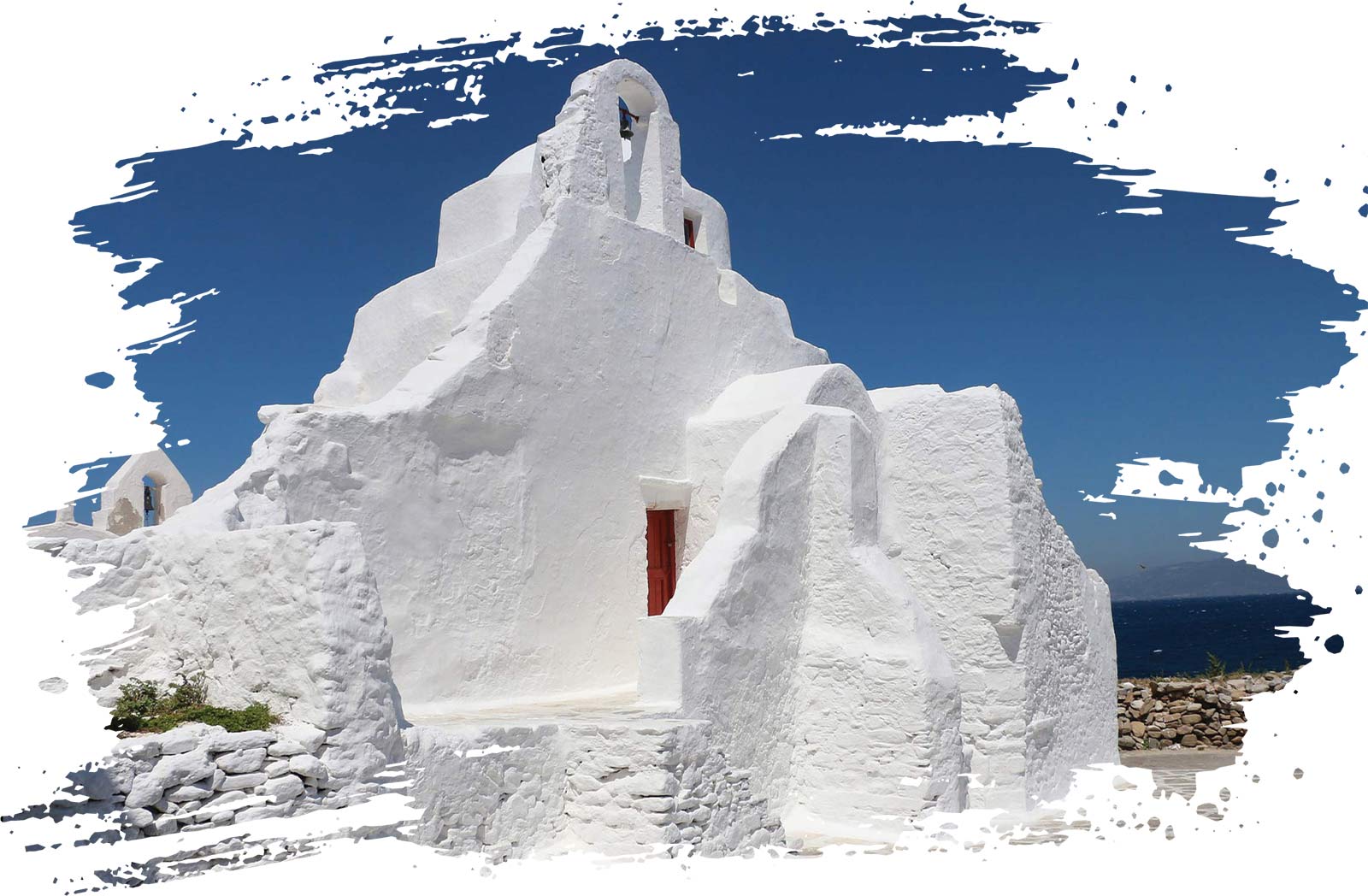
Paraportiani is a unique and remarkable architectural complex, in the creation of which not only man contributed, but also time, which with the accidental damage it caused, created a final result of unparalleled aesthetics. “Paraportiani” took its name from the fact that it is located next to the small NW gate, “the paraporti” of the medieval wall of Mykonos. It was first created between the 16th and 17th centuries and its architectural uniqueness has made it an important monument, not only for Mykonos, but also for the entire Aegean.
Zoodochos Pigi (Metropolis), Panchara, Agia Kyriaki, Agios Nikolaos tou Gialos, Agia Eleni
These churches are some of the many and remarkable post-Byzantine churches of Chora, with beautiful architecture, important icons and finely crafted icons. The large number of churches is explained by the many vows and the old habit of the Mykonians to place the bones of their dead on the walls of the churches.
Kalafatis – Divounia
To the SE of Ano Mera, opposite the beach of Kalafatis at the location of Divounia – Tarsanas, traces of a prehistoric (early Cycladic) Acropolis are preserved on the small twin cape.
Complex of Lower Mills
In the south of Chora, between the picturesque Alefkantra and the district of Niochori, oriented towards the sea, they impress the visitor with their all-white imposing volumes. Today, seven of the ten, which existed until the beginning of the 20th century and ground the local grain with the power of the north wind, are preserved. The mills of Mykonos supplied the island’s bakeries with ground wheat and flour, which, as a necessary stop for ships passing through the Aegean, supplied them, in turn, with rusks. One such monumental baker that still operates today with wood is the well-known “Giora’s Bakehouse” in Niochori.
Ftelia – Poros
Prehistoric buildings have been discovered in many parts of the island, such as in the area of Panormos bay. The most important Neolithic settlement is that of Ftelia. It is possible that the tomb of Ajax of Locros, a hero of the Trojan War who was worshipped in Mykonos, also existed in the same location since the archaic period.
The Monastery of Panagia Tourliani
It was founded in 1542 on the site of an old church of the Presentation of the Virgin Mary. From 1757 to 1767, the monastery, dedicated to the Assumption of the Virgin Mary, was renovated by the hieromonk Ignatius Basoulas and acquired its current form. The beautiful icons of the iconostasis belong to the hagiographer Ioannis “from Corfu”. The architecture of the complex, the rich relief decoration of the marble bell tower and the fountain impress the visitor. The monastery’s collections include old tools and utensils, important ecclesiastical relics, hierarchal vestments, furniture, post-Byzantine icons and various other offerings.
The Monastery of Paleokastro
This is an 18th century nunnery, a typical example of Cycladic monastic architecture, located north of Ano Mera. It owes its name to the nearby hill of the same name (“Paliokastro”) which is crowned by a medieval castle, Byzantine and subsequently renovated by the Gyzis. Among other things, in the same area, we visit the church of Agios Vlasis with its large dovecote and a peculiar prehistoric funerary monument, consisting of a large granite boulder which rises 3m. above the ground.
The Municipal Library
In addition to its 10,000 volumes (most of which belong to the historical library of Alexandros Meletopoulos), the Library houses a rich collection of photographs, 18th and 19th century documents, engravings, etc. It is located in Agia Kyriaki in Chora, on the ground floor of the magnificent Kampanis mansion (18th century).
The Three Wells
At the homonymous location in the center of the city today, these wells mainly ensured the water supply of Mykonos Chora from the mid-18th century until the 1950s.
The Town Hall
An elegant, tiled-roofed, two-story building from 1780 was constructed during the post-“Orlovika” period to serve as the headquarters of the Russian Consul General of the Archipelago. A few years later, it came under the jurisdiction of the Community (the local self-government body of the island that operated before the Revolution), to house the offices of the Municipality of Mykonos to this day. Next door, the simple and imposing “The Black” building was the first public school of Mykonos. It was built during the reign of King Otto (1859) to designs by the Bavarian engineer Weiler.